
Research with rectify
At rectify, we're not just focused on technological innovation – we also see ourselves as an active part of the scientific community. Our goal is to set new standards in back health with state-of-the-art sensor technology, sound data analysis, and a deep understanding of users. As a spin-off of the Technical University of Braunschweig, we build on an interdisciplinary foundation of research, technology, and health sciences. Our sensor technology allows for the first time the precise recording of spinal posture in everyday life – an area that was previously considered a scientific blind spot.
FlexLab Studio
Interactive Demo
With FlexLab Studio, we provide scientists and research institutions with a powerful analysis tool specifically developed for the needs of modern back health studies. The software enables drag-and-drop analysis directly within the user interface. Alternatively, the raw data can be exported in .csv format for in-depth, customized analyses.
Request your demo access now
Request Demo
Case Studies
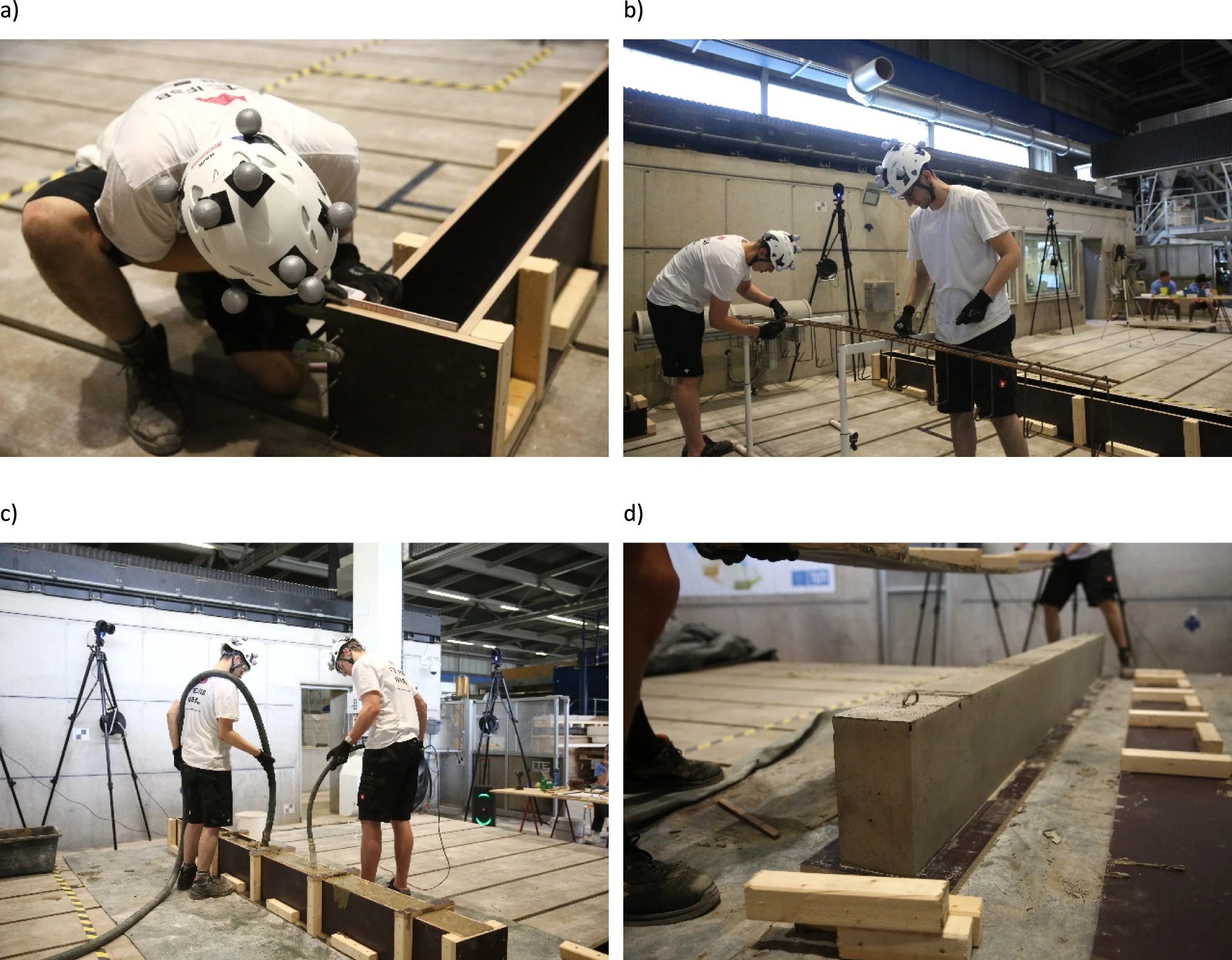
rectify in research at TU Braunschweig
At TU Braunschweig, our FlexTail sensor was used in a recent pilot study on shotcrete 3D concrete printing. Researchers examined psychophysiological strain, biomechanical spinal responses, and worker productivity compared to traditional concrete casting. FlexTail made this possible by delivering continuous, high-precision wearable data on spinal curvature as well as bending and rotation directly in the process. This allowed the team to objectively show that robot-assisted production reduces awkward back postures by 60% and lowers manually handled weight by 44%, while productivity increases threefold. The results highlight the potential of our sensor for ergonomic analyses in construction, helping protect skilled workers' health in the spirit of Industry 5.0.

Automatic recognition of daily activities
At the Peter L. Reichertz Institute for Medical Informatics (PLRI), the FlexTail sensor was used in two scientific studies on automatic recognition of everyday activities (Human Activity Recognition). The first study analyzed the classification of 22 different activities and achieved an accuracy of up to 98%. The second study compared the sensor's performance directly with video-based pose estimation systems. FlexTail enabled these studies because it can be worn unobtrusively under clothing and delivers precise real-time 3D data on spinal curvature. Compared to video analysis, the system works independently of camera angles or occlusions. The results show that the sensor provides more precise data than optical methods, particularly for seated activities and transition movements such as standing up. This qualifies FlexTail as a tool for long-term clinical monitoring and telemedical support in rehabilitation.

Clinical application: mobility measurement after scoliosis surgery
In a biomechanical pilot study at Asklepios Paulinen Clinic Wiesbaden, led by Dr. med. Wolfgang Marx and Prof. Dr. med. Thomas Niemeyer, our FlexTail sensor was used to investigate spinal mobility (Range of Motion, ROM). The study analyzed three-dimensional ranges of motion in adolescent patients with idiopathic scoliosis before and after corrective spinal fusion. FlexTail was used for computer-assisted, real-time measurement of flexion, extension, lateral flexion, and rotation in precise degrees. The results documented an immediate postoperative reduction in total mobility of around 60%. At the one-year follow-up, mobility stabilized at 34% below baseline. Due to the high reproducibility of the collected data, the sensor served as an objective instrument for perioperative long-term monitoring. The study confirms the clinical value of the FlexTail sensor for follow-up assessment and evaluating the healing process in spine surgery.
Let's talk about your research opportunity
Interested in a demo or exploring how rectify could support your research? Share a few details and we will get back to you.
We use your details only to follow up on your inquiry and coordinate a suitable demo or conversation.
Research inquiry
Leave us a few details about your research interest.
FAQ

Is your question not listed?
Send us your question here and we will write back to you as soon as possible.